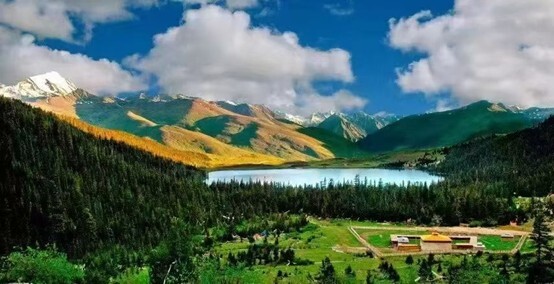
Photo by Li Deyou
To reverse the global trend of biodiversity loss, the Kunming-Montreal Global Biodiversity Framework (GBF), was adopted at the second part of the 15th Meeting of the Conference of the Parties to the Convention on Biological Diversity (COP15) in 2020. The framework sets a clear target to conserve 30% of the world’s terrestrial, inland water, and coastal/marine areas by 2030.
As a global biodiversity hotspot, the Third Pole—the Qinghai-Xizang Plateau and its surrounding mountain ranges—represents the world’s highest-altitude region with uniquely fragile ecosystems. It provides food, medicine, freshwater, and a wide array of critical ecosystem services to over 1.5 billion people across Asia, while forming an indispensable shields for ecological security for China and neighboring countries.
Therefore, safeguarding the biodiversity and ecosystems of the Third Pole has become a shared mission for the scientific community and policymakers in China and worldwide. As early as 2009, the Chinese Academy of Sciences (CAS) launched an international research initiative, Third Pole Environment (TPE) programme, dedicated to conservation of the Third Pole. It has since advocated for the conservation of the region’s vulnerable ecosystems through bodies such as the United Nations Environment Programme (UNEP) and publications in prestigious global academic journals.
From 2017 to 2025, China conducted the Second Comprehensive Scientific Expedition on the Qinghai-Xizang Plateau, an in-depth and systematic research endeavor. Concurrently, China implemented major national projects for the ecological protection and restoration of the Qinghai-Xizang Plateau Ecological Zone. In 2023, the Law of the People's Republic of China on the Ecological Protection of the Qinghai-Xizang Plateau was officially promulgated and enforced.
Despite these remarkable achievements, the Third Pole’s biodiversity conservation still faces severe challenges amid intensifying climate change, population growth, and accelerating urbanization.
A research team led by Prof. Yang Xuefei from the Kunming Institute of Botany, Chinese Academy of Sciences (KIB/CAS), has long conducted on-the-ground research on the conservation and sustainable use of biocultural diversity at the community level across the Third Pole.
Recently, the team, with Dr. Fu Yao as the first author and Associate Prof. Yang Lixin as the corresponding author, collaborated with experts from universities, research institutions, and international organizations across five countries in the Third Pole region (China, India, Nepal, Pakistan, and Thailand). Partner institutions included Nagaland University (India), Chiang Mai University (Thailand), Xishuangbanna Tropical Botanical Garden (CAS), Chinese Research Academy of Environmental Sciences (MEE), ICCA Consortium, United Nations Development Programme (UNDP), and the International Centre for Integrated Mountain Development (ICIMOD).
Together, they published a Letter titled " Support communities to conserve the Third Pole" in the journal Science. From the perspectives of ethnobotany and ethnoecology, the article presents a pivotal insight: achieving the long-term conservation and sustainable development of the Third Pole requires not only scientific research and policy implementation but also greater recognition and robust support for local communities’ biocultural conservation practices.
The article notes that human settlement on the Qinghai-Xizang Plateau dates back 4,000 years, fostering a rich and diverse tapestry of biocultural heritage. To this day, local communities continue to actively employ traditional knowledge to conserve the Third Pole’s vast grasslands, wetlands, lakes, forests, and farmlands.
Specific examples include:
Pastoralists on the plateau collaborating across communities and with scientists to develop innovative grassland restoration models.
Ethnic communities in the Himalayas safeguarding local biodiversity through traditional ecological wisdom.
Community-led initiatives around nature reserves effectively protecting rare and endangered species such as the snow leopard.
Communities in the Three-River Source Region and Hengduan Mountains proactively reducing plastic use and developing zero-waste communities to mitigate environmental pressures from tourism and changing lifestyles.
Crucially, these conservation efforts are primarily driven by cultural and social values, rather than solely by economic incentives or ecological compensation.
The article emphasizes that to maximize the impact of community-level conservation actions, broad societal support is essential. Scientists and policymaking must not only acknowledge the effectiveness and feasibility of community practices but also provide tangible support in four key areas:
Policy Support: secure community land tenure, enhancing their long-term motivation and capacity for conservation.
Scientific Collaboration: Establish long-term, site-based cooperative research relationships with local communities, moving beyond short-term project-based research.
Multi-Stakeholder Partnerships: Facilitate collaboration between communities, local government agencies, social organizations, and private sectors to explore synergistic pathways for conservation and development.
Addressing Gaps: Pay special attention to biocultural diversity conservation in urban communities across the Third Pole to fill current conservation gaps.
In January 2026, China officially implemented the National Park Law of the People's Republic of China, which explicitly encourages and supports community participation in national park conservation. Taking this supportive policy, scientists should work closely with local communities for Third Pole biodiversity conservation. This endeavor not only actively responds to the targets of the Kunming-Montreal Global Biodiversity Framework but also represents a critical pathway for contributing Chinese wisdom and solutions to global biodiversity conservation.
Contact:
YANG Mei
General Office
Kunming Institute of Botany, CAS
email: yangmei@mail.kib.ac.cn
(Editor: YANG Mei)