Ageratina adenophora (Spreng.) R.M. King & H. Rob., commonly known as crofton weed, ranks among the most destructive invasive species in China, causing estimated annual economic losses of approximately 3.62 billion RMB to agriculture and grassland ecosystems.
This aggressive invader releases toxic sesquiterpenes, including dehydrotremetone (DTD) and 9-oxo-10,11-dehydroageraphorone (HHO), which severely disrupt native ecosystems, inhibit livestock grazing, and compromise agricultural productivity. Conventional disposal methods—such as open burning or landfilling—often generate secondary pollution while failing to recover valuable biomass resources.
Against this context, the Specialized Research Group from Kunming Institute of Botany, Chinese Acdemy of Sciences (KIB/CAS), focus on Macrofungal Germplasm Resources and Green Development has established an innovative "composting pre-detoxification—black soldier fly (BSF) larval conversion" dual-phase bioconversion system, successfully transforming this "ecological killer" into premium biofertilizer through sequential detoxification and quality enhancement processes.
Phase I: Composting-Mediated Detoxification
Aerobic composting of A. adenophora for 56 days achieved >89% removal of toxic sesquiterpenes (DTD reduced from ~2000 to 220.8 mg/kg; HHO from ~700 to 96.4 mg/kg). Metagenomic analysis revealed enrichment of Proteobacteria, Actinobacteriota, and Bacteroidota, with Bacillus abundance reaching 32.4%.
These taxa drive toxin degradation via co-metabolic pathways, while lignin peroxidase and laccase activities increased 5.8–8.9-fold, enhancing lignocellulose decomposition and humification (humic acid: 35.9 vs. 16.1 g/kg in controls).
The process simultaneously mitigated multiple risks: bioavailable heavy metals (Cu, Zn, Cr, Pb) decreased by 73.9–97.9% through humic complexation and microbial biosorption; pathogen abundance (Xanthomonas, Staphylococcus, Salmonella) and key ARGs (NmcR, oleC, adeL) declined by >90%; multidrug efflux genes (MexS, mlaF) decreased by >75%. Mantel tests confirmed phytochemistry-driven "microbial regulation—chemical fixation—biological stabilization" synergies.
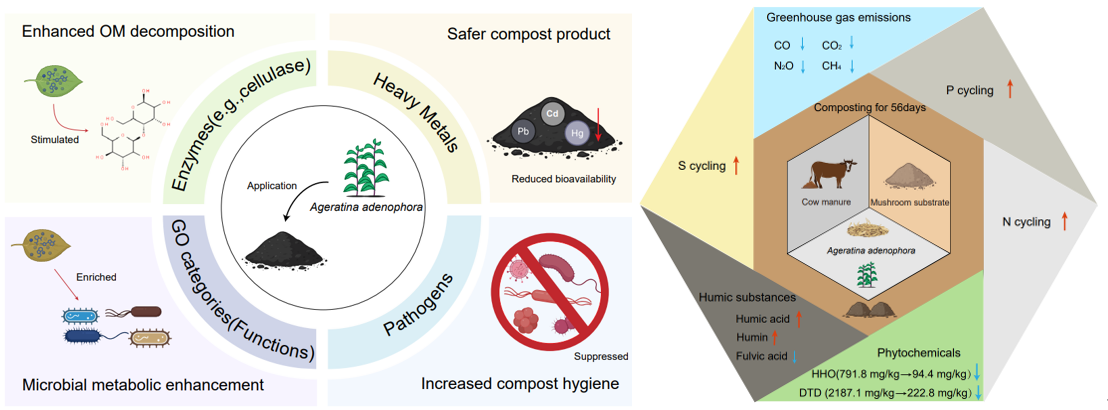
Figure 1. Aerobic composting-mediated detoxification of A. adenophora and co-composting with spent mushroom substrate: allelopathic toxicity reduction, heavy metal passivation, greenhouse gas mitigation, and microbial functional enhancement (Image by KIB)
Phase II: GHG Mitigation and Nutrient Retention
A. adenophora amendment (7.5–10%) suppressed CH₄ emissions to below detection limits by day 35 and reduced peak N₂O emissions by 52.2% via denitrifier inhibition. Functional genes showed upregulated nitrogen fixation (nifH: 13.4%) and nitrification (amoA: 70.1%), but downregulated denitrification (nirK/S, nosZ), reconstructing nitrogen metabolism and reducing gaseous losses. Nutrient enrichment was substantial: total N increased 2.15-fold (2.94 g/kg), P 15.6-fold (1.40 g/kg), and K 7.5-fold (3.21 g/kg), with germination indices of 98.9%.
Phase III: Black Soldier Fly Conversion
BSF larvae achieved secondary detoxification (DTD/HHO reduced by 65.2%/63.5%; total detoxification >96%) while exhibiting hormesis-based growth enhancement (70% weight gain). Larval processing further reduced exchangeable Cd/Pb by 67%/54%, increased total N/K by 30%/8%, and stabilized organic matter, with significant reductions in GHGs and odorous VOCs.
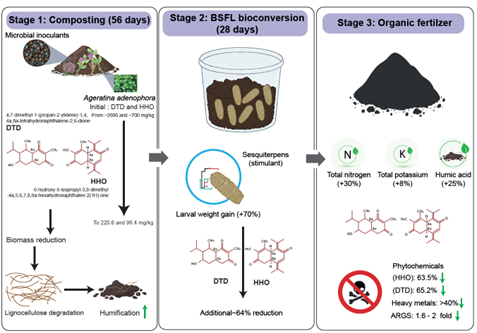
Figure 2. Schematic illustration of the two-step "composting–black soldier fly (Hermetia illucens)" biodetoxification and resource recovery system for A. adenophora (Image by KIB)
This research series provides the first comprehensive elucidation of the "Ageratina adenophora—microbes—black soldier fly" synergistic interaction: the composting phase achieves toxicity degradation, heavy metal passivation, pathogen elimination, and GHG reduction through phytochemistry-driven microbial community restructuring; the BSF phase completes secondary detoxification via gut microbial co-metabolism, while bioturbation enhances nutrient concentration and risk management. This two-phase approach constructs a complete technical chain for invasive plant resource utilization.
Compared to traditional composting, incineration, or landfilling, this technology offers three distinct advantages. Firstly, complete harmlessness throughout the process include: dual detoxification, heavy metal stabilization, ARG reduction, and GHG mitigation eliminate ecological risks. Secondly, high-value outputs. The final product serves as functional biofertilizer suitable for high-value crop production. Such as rare edible fungi, organic vegetables, specialty economic fruits, reducing chemical fertilizer and pesticide inputs. Thirdly, scalability. Utilizing locally available raw materials with straightforward processes, though collection costs remain a consideration, making it particularly suitable for A. adenophora-infested regions.
This research series was published in Chemical Engineering Journal , Journal of Hazardous Materials and Journal of Environmental Chemical Engineering .
Funding was provided by the National Key Research and Development Program, the Strategic Priority Research Program of the Chinese Academy of Sciences, the Yunnan Province Caiyun Postdoctoral Program, and the Yunnan Provincial Technology Innovation Program.
Contact:
YANG Mei
General Office
Kunming Institute of Botany, CAS
email: yangmei@mail.kib.ac.cn
(Editor: YANG Mei)